
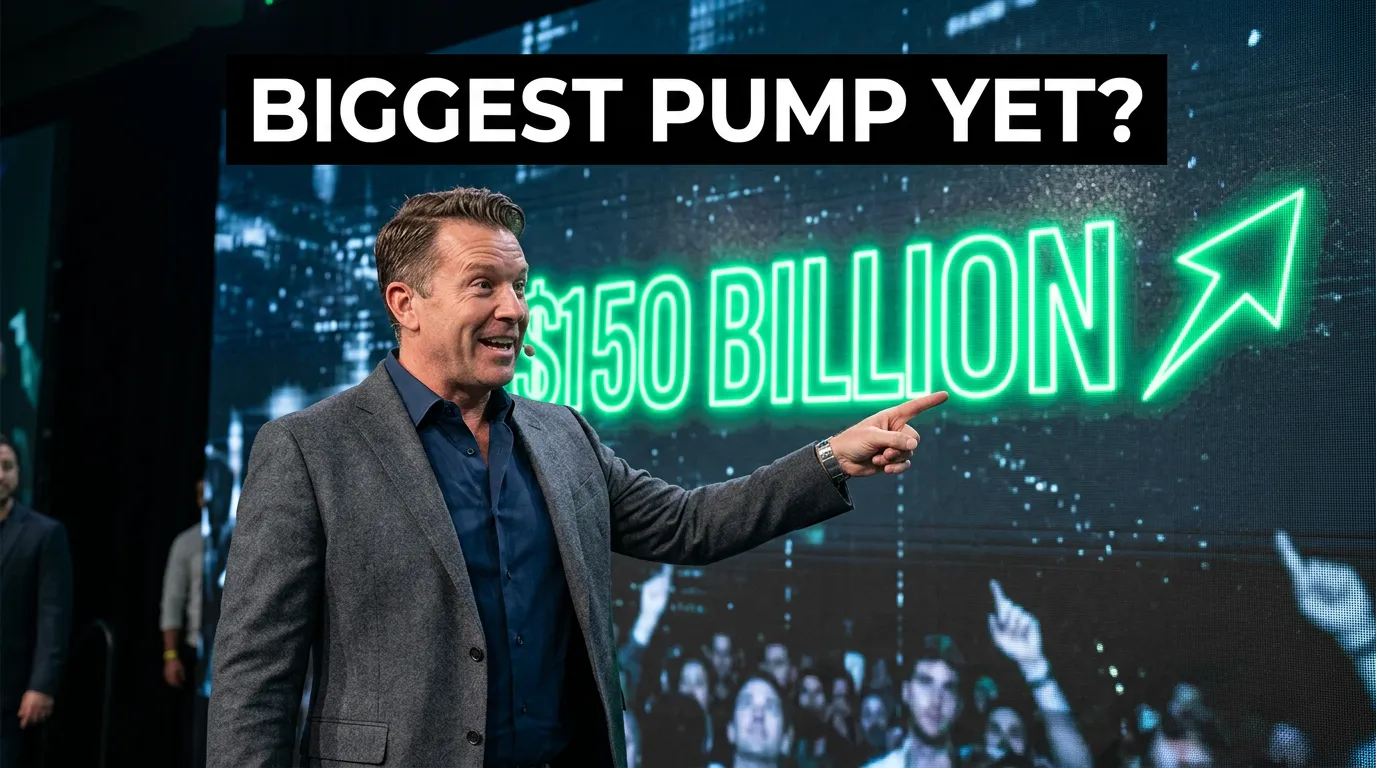
$150 Billion Is Coming For Crypto, and it may show up the same way every bull market seems to start: everyday people suddenly have extra cash. A late–Q1 tax-refund wave—potentially one of the biggest on record—could drop meaningful liquidity into checking accounts right as markets are already primed for volatility.
Did You Know?
Treasury Secretary Scott Bessent has floated a $100–$150B U.S. tax-refund wave in Q1, with roughly 60–70% of payments landing by late March—timing that can act like a mini liquidity event for risk assets.
Source: Video transcript summary (Scott Bessent estimate)
You’ll learn how refunds in the $100–$150B range could ripple into Bitcoin and Ethereum via exchanges like Coinbase and Kraken, plus the more indirect routes like Robinhood risk-on positioning. We’ll compare this setup to COVID-era stimulus behavior, map realistic scenarios for how much actually reaches crypto, and lay out practical steps—timing, position sizing, and risk controls—so you’re not reacting to headlines when the deposits hit.
The Refund Liquidity Event Explained
“$150 Billion Is Coming For Crypto” isn’t magic money printing—it’s mostly a timing story driven by refunds. The basic setup is that new tax changes (often framed as “Trump’s one big beautiful bill”) shifted what many households will owe looking ahead to 2025, while a lot of payroll withholding during 2024 didn’t perfectly track those new settings. When withholding runs “too hot,” people effectively overpay throughout the year and then get it back as a lump sum.
Why refunds are bigger this year
Withholding didn’t match new 2025-era tax settings, so many households effectively overpaid through 2024 and are now due larger refunds.
The size of the cash wave
Treasury Secretary Scott Bessent has floated $100–$150B in refunds in Q1, with a typical check close to $4,000.
The timing window matters
Roughly 60–70% of refunds are expected by late March, concentrating deposits in the latter half of March.
How it becomes tradable liquidity
Direct deposit hits bank balances, then flows into debit spending, brokerage transfers, and exchange on-ramps like Coinbase, Kraken, and Cash App.
Why March can feel ‘all at once’
Refund deposits stack on top of biweekly payroll, credit-card resets, and retail “risk-on” behavior—creating a short-lived liquidity spike.
On the official estimate side, Treasury Secretary Scott Bessent has discussed roughly $100–$150 billion in refunds landing in Q1, with an average refund near $4,000. The other key number is timing: about 60–70% of refunds are expected by late March. That’s why the second half of March is the bullseye—refunds don’t arrive smoothly; they bunch up around filing behavior, processing times, and direct-deposit rails.
Mechanically, this is how “refund liquidity” turns into market liquidity. Direct deposits hit checking accounts, which immediately loosens budget constraints: credit cards get paid down, “fun money” gets allocated, and transfers to investing apps become psychologically easier. For crypto specifically, the on-ramps are straightforward: ACH or debit purchases through Coinbase, Kraken, Gemini, and Robinhood Crypto, or smaller-ticket buys through Cash App and PayPal.
The reason it can feel like a spike is stacking. Refunds arrive on top of biweekly payroll cycles, month-end bills, and the natural retail habit of making bigger discretionary decisions when balances look temporarily inflated. A portion becomes spend, a portion becomes savings, and a portion becomes risk assets—meaning a short window where incremental demand can hit liquid markets fast, even if only a small percentage of the total refund pool actually routes to BTC, ETH, or high-beta altcoins.
Past Stimulus and Crypto: What History Tells Us
To understand what a potential $150B refund wave could do to crypto, it helps to rewind to the pandemic-era checks. The U.S. sent three big rounds to households: $1,200, then $600, then $1,400. Those payments didn’t just support spending; they also collided with the rise of app-based trading and a retail risk-on mindset.
On the behavior side, the pattern was consistent: when money hit bank accounts, attention and activity spiked. Retail traders moved quickly across Coinbase, Robinhood, Cash App (for Bitcoin), and even into higher-beta coins on exchanges like Binance.US (where available). But the key lesson is that “more activity” doesn’t automatically mean “massive net buying.” A lot of the action was churn—small trades, switching between assets, and short-lived bursts of speculation.
Stimulus Checks vs. Bitcoin: What the Data Actually Showed
Pandemic-era checks clearly nudged retail crypto activity, but measured flows were smaller than the social-media story. Use history as a calibration tool—not a guarantee.
- ✓ Three rounds: $1,200 → $600 → $1,400 checks coincided with higher retail trading
- ✓ Fed-linked research: ~3.8% bump in Bitcoin trading volume around payment dates
- ✓ Estimated price impact was modest (~0.07%) and direct allocation small (~0.02% of dollars)
That measured-vs-perceived gap matters. Academic-style estimates and Fed-linked findings suggested stimulus did increase Bitcoin trading volume (around 3.8%), but the average price effect was tiny (about 0.07%). Some studies went further and implied that only about 0.02% of total stimulus dollars flowed directly into Bitcoin purchases. In other words: the checks were a catalyst for engagement, not a firehose of net inflows.
So why did it feel bigger? Media anecdotes (“I turned my check into BTC”) and social platforms amplified the most extreme stories. A few viral wins on Twitter, TikTok, Reddit, and YouTube can reshape expectations, and expectations can move markets—especially in crypto, where narrative and momentum often matter as much as fundamentals.
What’s Different This Time
A refund wave isn’t a fresh stimulus program; it’s money many households mentally treat as “already theirs.” That can reduce the impulse to YOLO it. At the same time, the plumbing is easier now: instant bank transfers, debit-linked buying, and broader access via Coinbase and Robinhood can compress the timeline from “refund received” to “trade placed.” Also, today’s market has deeper liquidity (including spot Bitcoin ETFs), which can absorb retail flows with less obvious price impact—unless the narrative turns the cash event into a coordinated risk-on moment.
Scenarios: How $150B Might Reach Crypto
Scott Bessent’s $100B–$150B refund window is a timing event: a lot of cash landing in checking accounts in a tight period (with 60–70% arriving by late March). The crypto question isn’t “will all of it buy Bitcoin?”—it’s how much converts, how fast, and whether it concentrates into a few high-beta trades.
Conservative: curiosity buys
0.1% of refunds leak into crypto—mostly small BTC/ETH buys on Coinbase/Kraken via bank transfer or debit. Think many filers, tiny tickets, slower velocity.
Moderate: risk-on retail wave
0.5% of refunds rotate into crypto. More app-native flows: Robinhood Crypto and Cash App buys, plus USDC/USDT conversions on Coinbase/OKX that get redeployed into perps/altcoins.
Aggressive: narrative-driven sprint
1.5% of refunds hit crypto in a tight window. Higher concentration (fewer filers, larger amounts) plus social-driven meme runs; faster velocity into Solana tokens, perps, and DeFi deposits.
Put simple dollars on it using a $150B top-end refund pool: 0.1% is about $150M, 0.5% is about $750M, and 1.5% is about $2.25B. Those aren’t “market cap” numbers—they’re potential net new buy pressure and collateral, which matters most when it hits quickly and crowds into the same trades.
Channel analysis: where the money actually goes
Direct buys are the slow-and-steady path: ACH into Coinbase or Kraken, then BTC/ETH spot. This spreads flow across many filers, tends to be smaller ticket sizes, and usually has the cleanest impact—less reflexivity, fewer liquidations.
Trading platforms compress the timeline. Robinhood Crypto and Cash App make it “one tap from bank balance,” which increases velocity. Fast velocity matters more than raw dollars because order books reprice when everyone shows up at once.
Stablecoin conversions (USD→USDC/USDT on Coinbase, OKX, or on-chain via wallets like MetaMask) can act like a staging area. Even if users don’t buy BTC immediately, stablecoins become deployable ammo for perps, altcoins, and on-chain yields.
DeFi deposits are the second-order effect: USDC into Aave, ETH into Lido, or USDC routed to Solana venues like Jupiter for swaps. These don’t just “buy”; they create collateral, leverage capacity, and iterative trading loops.
Social-driven pump cycles are the wild card. The Fed-linked stimulus-era pattern in the transcript is the template: a small direct allocation can still spark a much larger narrative wave. A few viral TikToks or X threads can concentrate flows into the same meme tickers, amplifying short-term volatility.
The biggest difference across scenarios is concentration: a small percent from millions of filers is steady; a larger percent from fewer, higher-risk traders is lumpy and can move smaller caps fast.
What Traders and Investors Should Do
If $100–$150B in refunds really hits bank accounts with a heavy concentration in late March, treat it like a potential volatility window, not a guaranteed “number go up” event. Your edge is process: sizing, liquidity awareness, and not letting social media set your entries.
Size Like Volatility Is Coming
Cap risk per trade (e.g., 0.5–1% of account), use smaller leverage on perpetuals (Binance/Bybit), and predefine max daily loss so one March headline doesn’t wreck the week.
Check Liquidity Before You Click
On Coinbase Advanced, Binance, or Kraken Pro, look at order-book depth and spread; avoid thin pairs where a few refund-driven market buys can slip you 50–150 bps.
Stagger Entries, Not FOMO
Use laddered limit orders (3–5 tranches) or TWAP on exchanges; for spot, set buys at support levels, not on a viral “refund pump” candle.
Manage Stops and Take-Profits
Place stops where your thesis breaks (not where noise lives), consider trailing stops after a breakout, and scale out into strength (e.g., 25/25/50) to lock gains.
Choose Exposure Intentionally
Decide between spot BTC/ETH, short-dated options on Deribit, or market-neutral hedges (long spot + short perp) so you’re paid for basis/funding instead of guessing direction.
Long-term investor checklist (boring, effective)
- Avoid FOMO rules: if you buy, do it on a calendar (weekly DCA) via Fidelity Crypto, Coinbase recurring buys, or Swan Bitcoin—not because “refund season pump” is trending.
- Rebalance plan: set bands (ex: rebalance if BTC becomes >60% of your crypto sleeve) so spikes trigger trimming automatically.
- Tax-aware moves: track lots in CoinTracker or Koinly; consider harvesting losses before adding new exposure, and don’t create short-term gains accidentally with frantic flipping.
- Use refunds wisely: pay down high-interest debt first, then allocate a fixed slice (say 5–10%) to crypto so the decision is capped and repeatable.
Opportunistic ideas (if you’re experienced)
Market-neutral can beat directional guessing: long spot BTC on Kraken + short BTC perp on Binance to capture basis/funding, or hold USDC/USDT in Aave/Compound when yields beat your risk-adjusted spot thesis. If you trade pairs (BTC vs. ETH, or SOL vs. ETH), define what would invalidate the relative-value view.
Psychology and social-media risk
Viral narratives turn “maybe” into “must.” Put X/Twitter, Telegram, and YouTube on a delay: check once or twice daily, then trade your plan. If order-book depth is thinning and candles are vertical, assume you’re late—and act like it.



0 Comments