
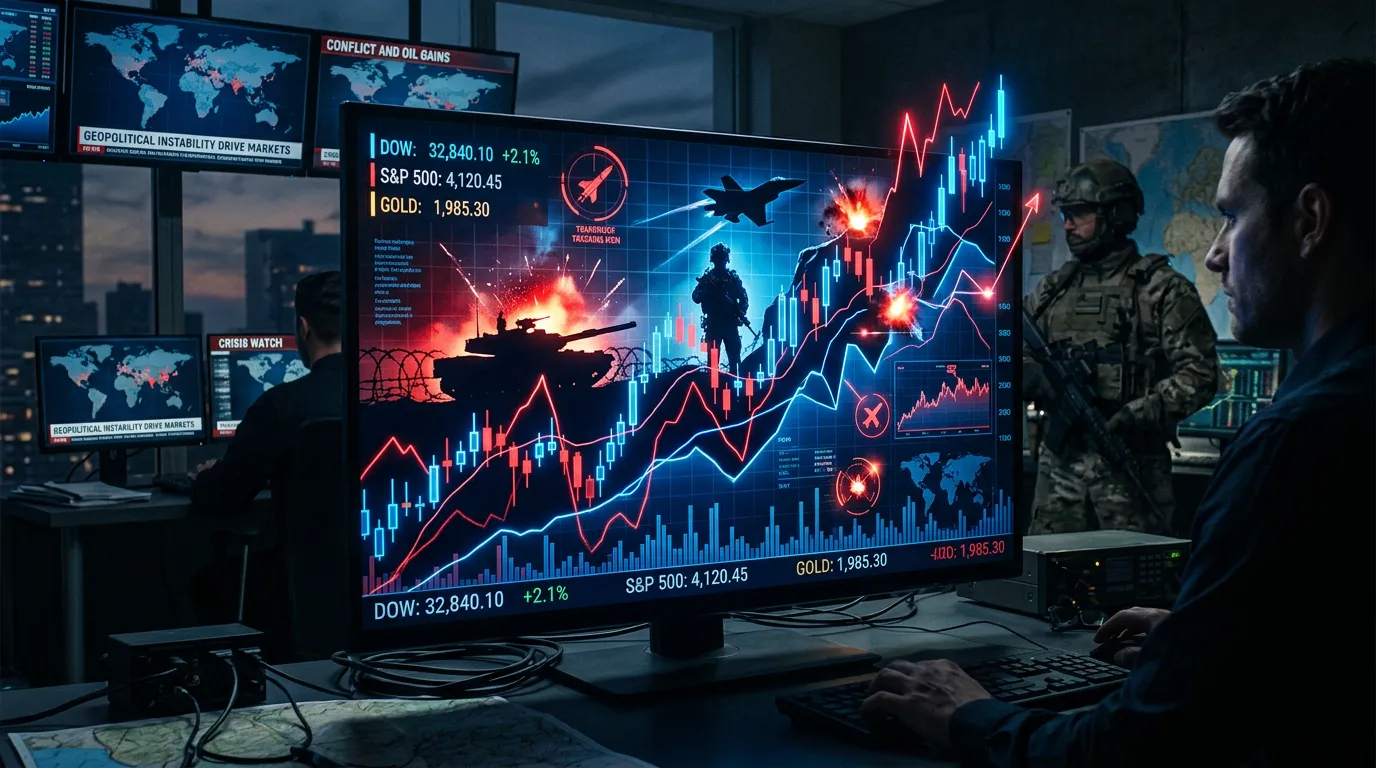
Understanding Market Reactions to Conflict
Conflict spikes trigger headlines and quick trading. In the short term, markets operate more like a voting machine than a precise engine of value, with sentiment driving up or down before fundamentals catch up. That reality invites discipline and a plan.
Fear and panic push many investors toward hasty decisions—selling at the bottom or fleeing sectors without a plan. The phrase "The US Iran War Will Make (Smart) Investors Rich l Here’s How" circulates as a provocative prompt, but savvy readers know to treat headlines as signals, not strategies. The point is to anchor decisions in data: earnings, cash flows, and long-term valuations rather than weathering headlines day by day.
Long-run market behavior, however, offers a different story. While fear can spark dramatic moves, the S&P 500 has shown remarkable resilience across multiple conflicts. The transcript notes that during the Korean War, when Eisenhower was in office, the index delivered roughly 142% total return over that period. Similar patterns appeared through the Vietnam War era and the Gulf War, where despite turmoil, equities posted meaningful gains over time. Even when headlines screamed crash, patient investors who kept to a disciplined plan often found opportunities as prices normalized. These examples underscore that disaster news rarely derails long-term progress if investors stay disciplined.
What does this mean for today? It means building a framework that treats volatility as a feature, not a flaw. Price swings create opportunities for those who buy quality at reasonable prices and who resist selling into panic. It also means differentiating between noise and signal, and rebalancing a portfolio to maintain a trusted mix of assets, currencies, and geographies. In practice, that translates to clear risk limits, a defined horizon, and regular review of core assumptions rather than knee-jerk reactions to every headline. A practical step is to separate strategic allocations from tactical shifts, using stop-loss controls and position sizing to manage fear-based bets.
Behavioral Footprints
Emotions drive short-term moves
Fear and headlines push investors to overreact, creating volatility and mispricings.
Fear vs. value
Dips can reveal quality assets at discounted prices for patient buyers.
Long-run resilience
History shows markets recover and trend upward despite wars and tensions; the S&P 500’s long-term trajectory has proven resilient.
Event-driven vs. fundamental trends
Prices swing on news, not on earnings capacity; fundamentals reassert themselves over time.
Historical recoveries
From the Korean War through the Gulf War, stocks have recovered and continued higher, often beyond initial reactions.
Historical Insights: Market Behavior in Times of War
Resilience Across Conflicts: Market Trajectories Over 75 Years
Across decades of conflict—from the Korean War to the modern era—markets have repeatedly faced fear-driven selling yet recovered and advanced over the long run. Short-term panics tend to fade as fundamentals reassert themselves, leaving patient investors better positioned to capitalize on compounding growth.
- ✓ Korean War: S&P 500 up about 142%
- ✓ Vietnam War era: strong relative gains despite inflation and protests
- ✓ Post-9/11 turmoil: sharp declines followed by sustained recoveries
- ✓ COVID-19 shakeups and the ensuing recovery and acceleration of tech-led growth
Patterns that emerge under fire
In the short run, fear governs prices more than fundamentals. News cycles amplify volatility as investors rush to reduce exposure. Yet the longer arc—the growth of earnings, innovation, and productivity—keeps pushing markets higher. The durability of corporate profits, coupled with adaptive economies and policy responses, tends to outlive the noise of any single conflict.
Case studies: Korean War, Vietnam War, 9/11, and recent conflicts
Korean War era: The early 1950s brought geopolitical tension, but the S&P 500 delivered meaningful progress, illustrating a powerful long-run trend that defies episodic fear.
Vietnam War era: Despite inflation pressures and social unrest, equities showed resilience as technology, consumer demand, and government policy supported corporate earnings growth.
9/11 and the early 2000s: The market experienced a sharp, panic-driven drawdown, yet by the mid-2000s equities had recovered and resumed a multi-year uptrend.
Recent conflicts and shocks: Markets responded with heightened volatility but recovered as liquidity, diversification, and strategic allocations anchored portfolios against downside risk.
Long-term growth versus short-term panic
The historical record—spanning roughly seven decades—consistently points to one conclusion: crises are temporary chapters, not the final pages. Markets have a proclivity to climb higher when investors focus on durable fundamentals—earnings strength, productivity gains, and adaptable economies—rather than episodic headlines. The lesson for readers is clear: fear can distort near-term prices, but patient, fundamentals-led investing tends to reward across business cycles and geopolitical shifts.
Over time, stock prices converge toward intrinsic value as companies innovate and deploy capital efficiently. Wars and rumors of wars create noise, not necessarily a new trend line. For investors, this means maintaining diversification, resisting timing bets on geopolitics, and preserving a steady course aligned with long-run growth—not with fear-driven, one-off headlines.
Identifying Investment Opportunities During the US-Iran Tensions
Geopolitical tensions create a split in market behavior: fear drives knee-jerk selling, while seasoned investors spot price dislocations that reflect sentiment rather than fundamentals. In the US-Iran context, the most consistent beneficiaries tend to be sectors with pricing power and resilience: defense contractors, energy majors, and commodity producers. History shows that crises shuffle the risk premium, not the long-run earning power of high-quality firms. When headlines spike, focus on companies with strong balance sheets, visible cash flows, and the ability to pass higher costs to customers.
Scan Geopolitical Triggers
Monitor headlines, policy shifts, sanctions timelines, and troop movements to understand catalysts.
Identify Sector Leaders
Focus on defense, energy, and materials firms with solid earnings, low debt, and pricing power.
Evaluate Valuation Under Stress
Find undervalued stocks due to fear, not deteriorating fundamentals; compare to peers.
Plan Tactical Entries
Use scaled entries, set stop losses, and rebalance as volatility evolves.
Defense names like Lockheed Martin (LMT), Raytheon Technologies (RTX), and Northrop Grumman (NOC) often show resilience when spending patterns shift toward security. Exchange-traded funds such as the iShares U.S. Aerospace & Defense ETF (ITA) or the SPDR S&P Aerospace & Defense ETF (XAR) provide broad exposure with lower company-specific risk. On the oil-and-gas side, ExxonMobil (XOM) and Chevron (CVX) can benefit from higher energy prices, while energy-focused ETFs like XLE offer diversified upside. In metals and minerals, Freeport-M�s Copper & Gold Mining (FCX) and gold proxies via SPDR Gold Shares (GLD) can hedge inflationary pressures that accompany conflict.
Look for undervalued stocks by screening for quality not fear. Favor firms with solid free cash flow, modest debt, and improving order books. Compare price multiples to peers and to the sector’s historical averages, and weigh near-term catalysts like sanction cycles or budget increases that could lift profits even if the macro backdrop remains uncertain.
To enter amid volatility, use a disciplined plan: scale into positions, employ limit orders, and set stop losses. Consider small starter allocations, then add as the story proves itself. Diversify across defense, energy, and commodities to avoid overconcentration, and use hedges like gold or broad-based volatility products to weather sharp moves.
Frequently Asked Questions
FAQ
What should I do if the market drops? ▼
Are there stocks that perform better during conflicts? ▼
How can I mitigate risks while investing during uncertain times? ▼
Conclusion
In times of conflict, emotions can drive snap decisions that erode long-term returns. By sticking to a rules-based approach—centered on fundamentals, diversification, and a pre-defined plan—you can navigate volatility without letting fear dictate trades.
🎯 Key Takeaways
- → Stay focused on long-term fundamentals rather than headlines or fear-driven moves.
- → Diversify, rebalance to risk tolerance, and use position sizing to weather volatility.
- → The US Iran War Will Make (Smart) Investors Rich l Here’s How by maintaining information discipline, screening for quality, and sticking to a pre-defined exit strategy.



0 Comments