
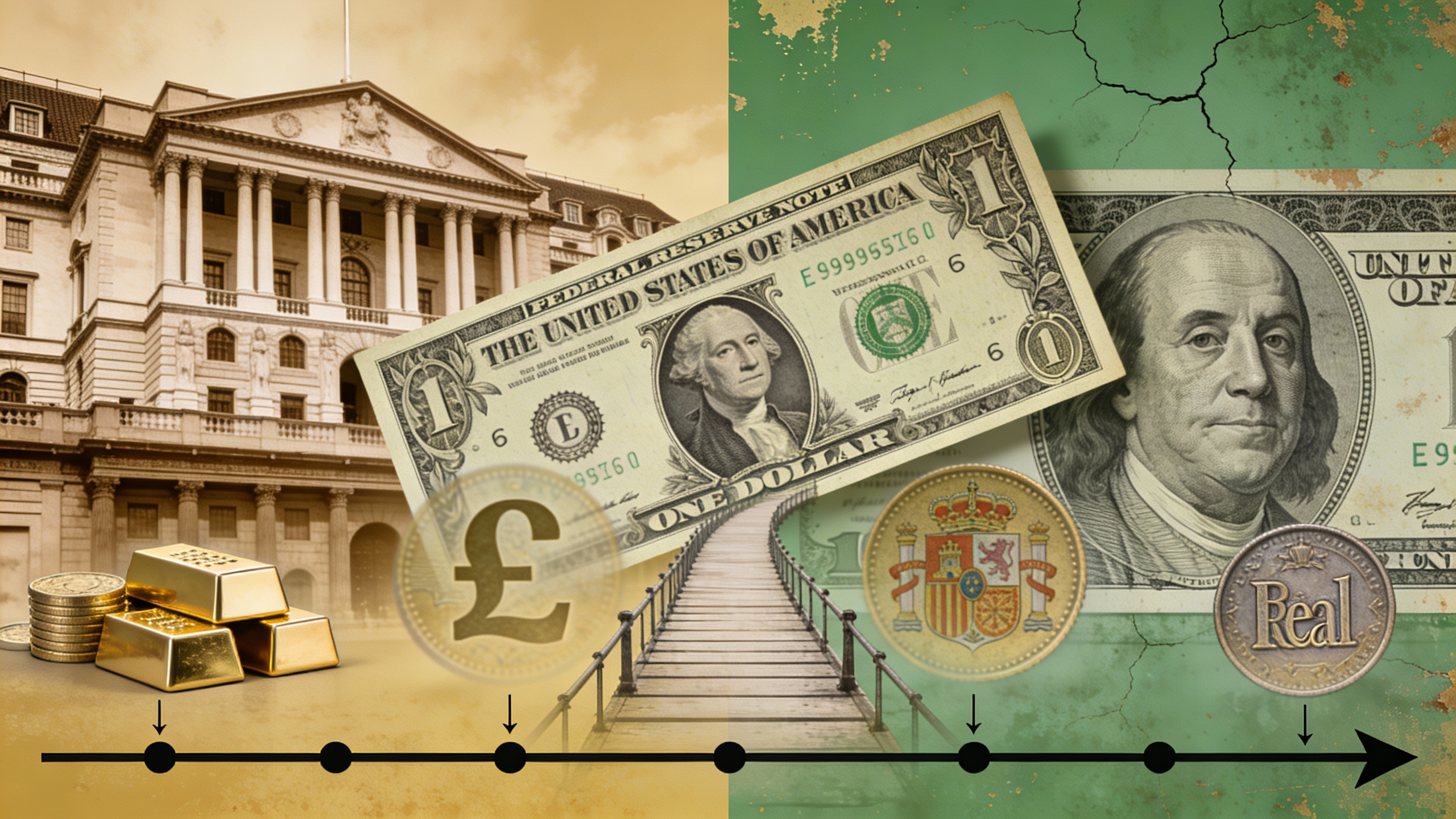
Picture this: Two centuries of unbreakable trust shattered in a single morning when Britain's Bank left the gold locked up behind the vault doors. What followed wasn't chaos, but a slow, predictable unraveling—a pattern repeated throughout history and eerily reflected in today's US dollar story. Let me take you through this riveting tale that blends empire, war, and economic reckoning, revealing what might just be the next chapter for America’s greenback.
The Dawn of a Currency’s Fall: Lessons from the British Pound
When you think about Dollar Collapse Phases and what history can teach us, the story of the British pound is a powerful example. On September 21st, 1931, the Bank of England did something unthinkable: it broke a 200-year promise by refusing to exchange pounds for gold. For two centuries, anyone holding British pounds could walk into the bank and swap them for gold at a fixed rate. But on that Monday morning, the gold stayed locked in the vault. This moment wasn’t chaos—it was the second act in a three-phase cycle that every holder of a global reserve currency should understand.
The Pound’s Peak: Global Dominance Before the Fall
In 1931, the British Empire still ruled over a quarter of the world’s population. The pound sterling wasn’t just a national currency—it was the backbone of global finance, settling 70% of international trade. London’s banks financed commerce from Shanghai to Sao Paulo. Yet, despite this dominance, Britain’s Chancellor of the Exchequer stood before Parliament and admitted the Empire could no longer honor its most basic financial commitment.
Phase One: War, Debt, and the Gold Standard Suspension
How does a currency so powerful begin to unravel? The answer lies in the repeating pattern of Historical Currency Reserve Status collapses. The first phase started on August 4th, 1914, as Britain entered World War I. The Empire’s trade routes spanned every continent, and the pound was trusted from Buenos Aires to Bombay. But the war’s financial demands were unprecedented. The Bank of England’s gold reserves stood at just 9.1 million pounds, backing 28.4 million pounds in paper currency. Financing the war meant suspending the gold standard—temporarily, or so Parliament believed. But this “emergency” measure would last far longer than anyone expected.
- 1914: 9.1 million pounds in gold reserves
- 1914: 28.4 million pounds in paper currency
- WWI spending: 9.4 billion pounds (about 475 billion pounds today)
This was the beginning of a 36-year decline, echoing the same pattern seen in other fallen reserve currencies. As history shows, “The privilege of reserve status finances excessive spending, the spending creates debt, the debt demands currency debasement, and debasement destroys trust.”
Phase Two: Attempts at Restoration and Erosion of Trust
After the war, Britain tried to restore the old order. In 1925, Winston Churchill returned the pound to its pre-war gold parity of $4.86, hoping to regain lost credibility. But the reality was harsh: the economy couldn’t support this value. British exports collapsed, and gold fled London for New York—220 million pounds’ worth between 1925 and 1931. The world watched as the pound’s value eroded, and when Britain finally abandoned gold in 1931, the pound instantly dropped 25% against the dollar. This was the slow, painful second phase of Dollar Depreciation Causes in action—loss of trust, mounting debt, and the inability to maintain the illusion of strength.
- 1925: Churchill returns pound to gold at $4.86
- 1925–1931: 220 million pounds in gold leaves London
- 1931: Pound drops 25% after gold standard break
Phase Two’s Long Shadow: Repeated Devaluations
Even after the 1931 collapse, the pound remained central to world trade. In 1939, London still cleared 40% of global transactions. But the costs of World War II—another 34.4 billion pounds—pushed Britain deeper into debt. By 1949, the pound was devalued from $4.03 to $2.80. In 1967, it fell again to $2.40. Each devaluation marked another step in the loss of reserve status, as the world’s trust shifted elsewhere.
- 1949: Pound devalued from $4.03 to $2.80
- 1967: Pound devalued from $2.80 to $2.40
The privilege of reserve status finances excessive spending, the spending creates debt, the debt demands currency debasement, and debasement destroys trust.
The British pound’s journey from dominance to decline is a textbook example of how reserve currencies fall—through war, debt, failed restoration, and the slow but steady erosion of global confidence. Understanding these phases is crucial for anyone watching today’s dollar.
Spain’s Silver Empire: The Original Currency Collapse Cycle
When you think about historical currency reserve status, it’s easy to imagine the dollar’s current role as something new or unique. But the cycle of rise and decline has played out before—most dramatically with Spain’s Silver Empire in the 16th century. The story of Spain’s currency collapse isn’t just a history lesson; it’s a blueprint for understanding dollar depreciation causes and the risks that come with the privilege of issuing the world’s reserve currency.
Philip II’s Inheritance: Silver Riches and Immediate Debt
In 1556, Philip II inherited the Spanish throne and, with it, the world’s largest silver mines. The legendary Potosi mine alone was producing a staggering 150 tons of silver every year. Spain suddenly had more monetary metal than any other nation in history—an unimaginable advantage. But instead of using this wealth to build a sustainable empire, Philip II made a fateful choice: he began borrowing against future silver revenues almost immediately.
By 1557, just one year into his reign, Spain’s royal debt had already soared to 36 million ducats. The loans came from powerful German banking houses like Fugger, who were eager to lend against Spain’s seemingly endless silver supply. This was the first sign of a pattern that would repeat throughout history: the temptation to spend more than your economy produces, simply because you control the world’s money.
The Spanish Real: Global Trade Dominance
At its peak, the Spanish real was the dollar of its day. Merchants from Lisbon to Manila accepted it without question. Spain’s silver coins became the backbone of global trade, just as the British pound would centuries later—and just as the dollar is today. This historical currency reserve status gave Spain enormous power, but it also created a dangerous privilege: the ability to print or issue currency beyond the true value of the underlying economy.
The pattern isn’t random or antiquated. It repeats because the privilege itself contains the mechanism of destruction.
Debt Spiral and the First Signs of Collapse
But the borrowing never stopped. Over the next four decades, Spain’s royal debt ballooned. By September 1596, Philip II was forced to declare his third bankruptcy in just 40 years. The royal debt had exploded to 85.5 million ducats—almost three times the annual silver revenue flowing in from the New World. This unsustainable debt was a direct result of the privilege to issue the world’s reserve currency without restraint, a key dollar depreciation cause echoed in later empires.
Currency Debasement: Eroding Trust and Value
As the debts mounted, Spain turned to currency debasement to stretch its resources further. The government began mixing copper with silver in its coins, hoping to make the precious metal go further. Within three decades, the silver content in Spanish copper coins had been cut by half. This debasement was a clear signal to the world: Spain’s economic foundation was weakening, and trust in its currency was eroding.
- Annual silver production from Potosi: 150 tons
- Royal debt by 1557: 36 million ducats
- Royal debt by 1596: 85.5 million ducats
- Silver content reduction in copper coins: 50% within 30 years
Loss of Reserve Status: Trade Partners Turn Away
As Spain’s coins lost value, European trade partners began to refuse them. The once-dominant Spanish real was no longer trusted. Silver that had once flowed into Madrid now diverted to Amsterdam, fueling the rise of Dutch merchants and shifting the center of global commerce. This marked the second phase of the currency collapse cycle: the loss of international trust and the end of Spain’s monetary dominance.
Spain’s experience shows how quickly the privilege of reserve currency status can turn into a trap. The cycle from debt buildup to currency debasement and eventual rejection by trade partners played out over just 30 years—a stark reminder that the forces behind historical currency reserve status and dollar depreciation causes are as old as global trade itself.
The Bretton Woods Trap: How America’s Dollar Became a Double-Edged Sword
Picture this: It’s July 1944. World War II is still raging, but at the Mount Washington Hotel in Bretton Woods, New Hampshire, representatives from 44 nations are already planning the postwar financial world. The United States sits at the head of the table, holding two-thirds of the world’s monetary gold and an economy untouched by war. Britain, on the other hand, arrives essentially bankrupt, having spent every ounce of imperial wealth fighting Hitler. The Soviet Union sends observers but refuses to join the final agreement. The stage is set for the US dollar to become the world’s reserve currency, backed by gold.
This new system, known as the Bretton Woods System, was hailed as an American triumph. On paper, it looked simple and strong: the US agreed to convert dollars to gold at a fixed price of $35 per ounce. Every other currency pegged its value to the dollar. For example, the British pound was set at $4.03, the French franc at $1.19 per dollar, and the German mark at $3.33 per dollar. The dollar became the bridge between all other currencies and gold. This arrangement made the dollar the world’s reserve currency, a position that would shape global finance for decades.
The Trap Hidden in Triumph
But here’s the catch—the elegant trap at the heart of the Bretton Woods System impact. To supply the world with enough dollars for international trade, America had to run trade deficits. In other words, the US needed to import more than it exported, sending dollars abroad through purchases of goods like French wine or German machinery. As a result, “every dollar we sent overseas... could theoretically be redeemed for US gold at $35 an ounce.”
This mechanism was mathematically unsustainable. As foreign central banks accumulated more dollars through their trade surpluses, they held more claims on America’s gold reserves than physically existed in US vaults. By 1959, foreign claims on US gold had reached $19.4 billion, while US gold reserves stood at just $19.5 billion. The margin had all but disappeared.
Robert Triffin’s Warning
Economist Robert Triffin saw the flaw immediately. In 1959, he warned Congress that the system was doomed: if the US kept supplying dollars to the world, eventually foreign claims would outstrip American gold reserves. He predicted a crisis within ten years. He was off by only 18 months.
Cracks in the System: France and Germany Test the Dollar
The cracks started to show in the 1960s. French President Charles de Gaulle, advised by Jacques Rueff, began converting France’s dollar reserves to gold—$150 million every month. By 1968, France had exchanged $750 million, exposing the shortfall: US gold reserves of $14.5 billion were backing $28 billion in foreign dollar claims. Germany followed suit. On May 5th, 1971, the Deutsche Bundesbank received $1 billion in dollar inflows in a single morning and requested to convert excess dollars to gold. The US Treasury refused. The mechanism was now visible to anyone paying attention: America could not honor its promises without emptying Fort Knox.
The Collapse: Nixon Closes the Gold Window
By 1971, the numbers were staggering. Foreign dollar claims had ballooned to $80 billion, while US gold reserves, still valued at $35 per ounce, were worth only $10.2 billion. When Britain requested to convert $3 billion in sterling reserves to gold, the US faced a stark choice: honor the request and risk a run on gold, or break the promise. President Nixon chose the latter. On August 15, 1971, he appeared on national television and announced the closure of the gold window, ending the dollar’s convertibility to gold. The Smithsonian Agreement that followed devalued gold parity to $38 per ounce but kept the gold window closed.
“Every dollar we sent overseas... could theoretically be redeemed for US gold at $35 an ounce.”
This was the end of the Bretton Woods System impact and the beginning of a new era for the dollar reserve currency. The dollar’s fixed gold backing had become a double-edged sword—one that ultimately forced the US to abandon gold convertibility and set the stage for future challenges, including concerns about dollar devaluation in 2025 and beyond.
The Dollar’s Long Phase Two: Why the Decline Feels Endless
When you look at the history of global reserve currencies, you’ll notice a pattern: each currency goes through three distinct phases. Phase two is the period after a currency’s dominance is first challenged, but before its status collapses. Historically, this phase lasts about 10 to 20 years. But here’s the catch— the US dollar has been stuck in phase two for over 50 years. That’s not just unusual; it’s an outlier in the story of global money.
How Long Is Too Long? Comparing Dollar Bear Cycles to History
Let’s put this in perspective. The British pound, which held the world’s reserve currency crown before the dollar, managed to stay in phase two for just 36 years before it entered a terminal decline. Go further back, and you’ll see the Spanish real lasted 71 years across all three phases— not just phase two. So, the US dollar’s 53-year run in phase two since 1971 is already more than a decade longer than the pound’s, and it’s closing in on the Spanish real’s entire reserve lifespan.
This matters because, as history shows, the longer phase two extends, the more violent phase three becomes. Why? Because imbalances—like debt, trade deficits, and global dependency—build up to unsustainable levels. When the shift finally comes, it’s rarely gentle.
From Gold to Fiat: The Structural Shift That Changed Everything
Phase two for the dollar began in 1971, when President Nixon closed the gold window. This ended the dollar’s direct convertibility to gold, launching the world into a new era of pure fiat currency. No more gold backing meant the US could print dollars at will, and it did—$80 billion worth overseas in the years following. This unleashed a wave of inflation concerns and set the stage for the dollar’s current structural pressures.
Since then, the Federal Reserve’s policies, along with global shocks like oil crises and financial meltdowns, have driven repeated dollar bear cycles and bull cycles. But the underlying trend is clear: the world’s trust in the dollar’s stability is slowly eroding.
De-dollarisation Process: Quiet Shifts, Not Loud Announcements
Here’s something crucial to understand: phase three doesn’t announce itself with a presidential speech, but with quiet policy shifts. You won’t see a headline saying “The Dollar’s Reserve Era Is Over.” Instead, you’ll notice a series of subtle moves by countries and central banks:
- Central banks are increasing their gold reserves and diversifying away from the dollar.
- China’s yuan is being used more often in global trade settlements, especially through its CIPS payment system.
- New payment networks are emerging, reducing dependency on SWIFT and the dollar.
- Recent geopolitical moves, like the removal of major Russian banks from SWIFT in February 2022, signal growing cracks in the dollar system.
Each of these steps may seem minor on its own, but together, they point to a larger de-dollarisation process and mounting dollar structural shifts. The impact? Countries are quietly preparing for a world where the dollar isn’t the only option— or even the preferred one.
Mounting Imbalances: The Dollar Dependency Impact
Why does this prolonged phase two feel endless? Because the imbalances just keep growing. US national debt is at record highs, and interest expenses are ballooning. Meanwhile, the rest of the world is less willing to fund America’s deficits. As trust in the dollar’s stability wanes, the risk of a sharp, disruptive transition—what some call a “violent” phase three—grows.
Since 2020, you can see the pattern accelerating. The world is watching, and acting, even if it’s not always obvious. The dollar’s long phase two isn’t just a historical curiosity; it’s a warning sign. The longer it lasts, the more dramatic the eventual shift is likely to be.
The longer phase two extends, the more violent phase three becomes.
Phase three doesn’t announce itself with a presidential speech, but with quiet policy shifts.
Modern Echoes of Currency Collapse: A Glimpse into 2020s and Beyond
When you look at the history of reserve currencies, there’s a hidden cycle that repeats itself—one that’s easy to miss until you know what to look for. The U.S. dollar has been the world’s dominant reserve currency for decades, but if you pay attention to recent events, you’ll notice subtle signals that suggest we’re entering a new, more turbulent phase. As you read on, keep this question in mind: Have you noticed the pattern developing since 2020? It reveals itself through quiet policy shifts that seem unrelated until you recognize the pattern.
Sanctions and Exclusions: Quiet Signals of Phase Three
Unlike past currency collapses, the transition away from the dollar isn’t announced with a bang. Instead, it’s happening through a series of policy moves and international decisions that quietly undermine the dollar’s dominance. A key moment came on February 26th, 2022, when Western nations removed major Russian banks from the SWIFT system—the backbone of dollar-based international payments. While this was presented as a sanction against Russia for its invasion of Ukraine, it also sent a powerful message to the world: access to the dollar system can be weaponized and is no longer guaranteed.
These actions may seem isolated, but they’re part of a larger trend. As history shows, the longer a reserve currency stays in phase two—the period of peak dominance and growing imbalances—the more violent and disruptive phase three becomes. The British pound only managed 36 years in phase two before its terminal decline. The Spanish reserve era lasted 71 years in total. The U.S. dollar has now exceeded the typical phase two timeline by more than a decade, making its current status an outlier and setting the stage for a potentially sharper correction.
Geopolitical Shifts and the Fragmentation of Dollar Dominance
The Russia-Ukraine conflict didn’t just trigger sanctions; it accelerated a global reevaluation of the dollar’s role. Countries saw how quickly access to dollar-based systems could be cut off, and many began seeking alternatives. This fragmentation is a classic sign of phase three in the reserve currency cycle—where trust erodes and nations hedge their bets.
Emerging payment systems are gaining traction, with countries like China and India promoting their own platforms and settling more trade in local currencies. Central banks are also increasing their gold reserves at a rapid pace, signaling a lack of confidence in dollar liquidity. The dollar index, which measures the dollar’s strength against other major currencies, fell 11% in the first half of 2025—its largest drop in decades. These are not random events; they’re symptoms of a deeper shift.
Accelerating Dollar Devaluation and the Rise of Alternatives
As the dollar’s status is questioned, you’re seeing a rush into hard assets like gold and a growing interest in digital currencies. Central banks are hoarding gold, and new payment systems are emerging to bypass the dollar altogether. This is classic behavior in the late stages of a reserve currency’s life cycle—when inflation and currency debasement become more pronounced, and trust in the system starts to break down.
What If the Dollar Loses Reserve Status Rapidly in 2026?
Let’s imagine a scenario where the U.S. dollar loses its reserve status quickly, perhaps as soon as 2026—a possibility some analysts now predict. The economic consequences of dollar decline could be severe:
- Market volatility: Global markets could see wild swings as capital flees the dollar for safer assets.
- Shifts in capital flows: Investment might move away from U.S. assets, raising borrowing costs and pressuring the U.S. economy.
- Inflationary pressures: As the dollar devalues, import prices could soar, fueling inflation at home.
How to Prepare for the Changing Dynamics Ahead
If you’re concerned about Dollar Devaluation 2025 and what comes next, consider these steps:
- Diversify your investments to include assets outside the dollar system.
- Stay informed about emerging payment systems and alternative stores of value like gold.
- Monitor global policy shifts—often, the most important changes happen quietly, not with major announcements.
Have you noticed the pattern developing since 2020? It reveals itself through quiet policy shifts that seem unrelated until you recognize the pattern.
By connecting these dots, you can better understand the Dollar Decline Consequences and position yourself for the economic realities of the years ahead.
Wild Card: Imagining a World Without Dollar Dominance
Let’s play out a scenario that, just a decade ago, would have sounded unthinkable: the US dollar loses its reserve currency crown, not in some distant future, but within your lifetime. If you’ve followed the hidden cycle of reserve currencies, you know this isn’t just a financial story—it’s about power, trust, and the way the world does business. So, what would a sudden Dollar Transition actually look like, and how might it impact your life and investments?
Dollar Dependency Impact: The End of an Era
Imagine waking up to headlines: “Dollar’s Share of Global Reserves Plunges Below 40%.” It wouldn’t just be a number on a chart. The world’s trade, investment flows, and even the price of your morning coffee would feel the ripple. For decades, the dollar’s dominance has meant stability—oil priced in dollars, global loans settled in dollars, and central banks everywhere holding greenbacks as their safety net. If that net suddenly shrinks, volatility becomes the new normal.
History shows us that when a reserve currency loses trust, the shift isn’t gradual forever. It’s like a balloon with a slow leak—until, one day, it pops. The British pound’s decline after 1931 seemed manageable for years, but when phase three hit, it was swift and brutal. The same pattern could play out for the dollar, but with a twist: today’s world is more interconnected and digital than ever.
Multipolar Money: The Rise of Competing Currencies
So, what replaces the dollar? Not one currency, but many. We’re already seeing the Dollar Structural Shifts as countries like China, Russia, and India settle trade in yuan, rubles, and rupees. The euro, gold, and even digital currencies are stepping up. Saudi Arabia now accepts yuan for oil; central banks are stockpiling gold; and new payment systems like CIPS and Nim Bridge are bypassing the dollar altogether. This isn’t just economic—it's geopolitical and technological.
- Yuan and Euro: China and Europe gain more influence in global finance.
- Gold: Central banks use gold as a neutral anchor, especially in times of crisis.
- Digital Currencies: Blockchain-based payment systems allow instant, borderless settlements.
In this multipolar world, no single currency will dominate. Instead, you’ll see a basket of options, each with its own strengths and risks. The privilege of reserve status—what historian Charles Kindleberger called “an exorbitant privilege”—is now up for grabs, and the competition is fierce.
New Challenges: Volatility, Inflation, and Innovation
What does this mean for you? Expect more currency swings, higher import prices, and, at least for a while, disrupted markets. If the dollar drops 25% overnight, as the pound did in 1967, US consumers could see the cost of imported goods soar. But there’s a flip side: innovation. As old systems break down, new ones emerge. Digital payment networks, decentralized finance, and alternative stores of value like gold or even Bitcoin could thrive.
Personal Perspective: Diversifying Beyond the Dollar
Let me share a quick story. In 2018, I met an investor who had always kept 100% of their portfolio in US stocks and bonds. By 2022, watching the Dollar Dependency Impact accelerate, they began shifting—adding gold, international stocks, and even a small basket of emerging market currencies. “It’s not about abandoning the dollar,” they told me. “It’s about not betting everything on one horse.” That mindset, rooted in historical cycles, is more relevant than ever.
Why History’s Cycles Matter for Your Money
Understanding the phases of reserve currency decline isn’t just academic—it’s practical. When you see the signs of phase three, you can prepare: diversify your assets, hedge against inflation, and stay nimble as new opportunities emerge. As one expert put it,
“Reserve currency’s privilege contains the mechanism of destruction built into its structure.”
History doesn’t repeat, but it rhymes. The dollar’s story may not end with a bang, but with a rapid, irreversible shift—one you’ll want to see coming before the balloon finally pops.
Conclusion: The Silent Countdown of Dollar Depreciation
If you’ve followed the journey of the world’s reserve currencies, you know there’s a pattern that repeats itself through history. The story of the dollar decline isn’t just about numbers on a chart or headlines in the news—it’s about understanding the hidden cycle that has played out with every global currency before it. From the Spanish real to the British pound, and now the US dollar, the phases are clear: privilege, debt, debasement, and, ultimately, collapse.
Britain and Spain offer us blueprints for what happens when a currency sits at the top for too long. Both nations enjoyed the privileges of reserve status—easy borrowing, global demand, and unmatched influence. But privilege breeds complacency. Over time, debt piles up, and the currency gets stretched thin as governments try to maintain their global standing. Eventually, debasement follows, as leaders resort to printing more money or manipulating policy to keep the system afloat. Collapse doesn’t come with a bang, but as a slow, silent countdown that only becomes obvious in hindsight.
The US dollar’s journey is unique, but it’s not immune to this cycle. The Bretton Woods agreement in 1944 was both a victory and a trap for the dollar. It cemented the dollar’s dominance, but also set in motion the very forces that now threaten its future. Since then, the US has enjoyed decades of privilege, but the warning signs of phase two—debt and imbalances—have been flashing for years.
Here’s where things get interesting. According to historical patterns, phase two—the era of mounting debt and growing imbalances—usually lasts a few decades. But as you’ve seen, we’ve already exceeded the typical timeline by more than a decade. That tells you something important: the longer this phase stretches, the more violent and disruptive phase three can become when it finally arrives. Imbalances don’t just disappear; they build up quietly, waiting for a trigger.
Since 2020, the signs of a coming transition have become harder to ignore. Specific decisions, made by specific countries on specific dates, are quietly shifting the ground beneath the dollar. Take February 26th, 2022, for example. On that day, Western nations removed major Russian banks from SWIFT, the dollar-based payment messaging system that underpins international transactions. This move was presented as a severe sanction—a punishment for Russia’s invasion of Ukraine—but it also sent a powerful signal to the rest of the world: the dollar’s role as a neutral, global medium of exchange is no longer guaranteed.
Phase three of the dollar collapse doesn’t announce itself with a presidential address or a central bank declaration. Instead, it reveals itself through quiet policy shifts that seem unrelated until you recognize the pattern. Countries begin to diversify their reserves, seek alternatives to the dollar, and build new payment systems. These actions may seem small, but together they mark the silent countdown of dollar depreciation.
The question is recognizing when phase three has already begun. The dollar’s journey is a story still being written, but history tells us that transitions are inevitable, even if their timing is uncertain. Recognizing the signs of each phase can help you make smarter financial and policy decisions. Instead of panicking, you can anticipate and adapt. Learning from history is our best defense against the economic shocks that come with currency transition.
So, as you watch the headlines and track the data, remember: the silent countdown of dollar depreciation is already underway. Understanding the hidden cycle of dollar decline won’t just help you survive the next phase—it will help you see the opportunities that come with every great transition. Stay vigilant, stay informed, and let history be your guide.
TL;DR: Reserve currencies rise and fall in predictable phases driven by debt, military spending, and trust erosion. Britain's pound and Spain's real reveal the destructive cycle of privilege and decline, a blueprint now echoing with the US dollar deep in its phase two and heading towards an inevitable transition.



0 Comments